

Fractional vs. PEO



Fractional HR vs. PEO vs. In-House: How to Pick the Right Model for a Scaling Company
Most founders make this decision based on whoever pitched them last. A PEO sales rep calls at the right moment and suddenly you’re bundled into a co-employment agreement. A recruiter sends over a strong HR candidate and suddenly you’re onboarding a head of people into a system that doesn’t exist.
The model should follow the problem. Here’s how to match them.
The reframe
None of these models is better than the others. Each one is right for a specific moment. The mistake isn’t picking the wrong model – it’s picking the right model for the wrong stage.
PEO: right for one thing
A PEO stabilizes HR administration fast. Payroll runs, benefits are bundled, compliance basics are handled. If you need to stop the bleeding immediately, a PEO does that.
What it doesn’t do: build your operating model. A PEO won’t install comp architecture, tighten your hiring workflow, clean your HRIS data, or create reporting your board trusts. When you outgrow it – and you will – there’s nothing underneath. The exit is expensive and the mess is yours.
Use a PEO when the pain is admin coverage and you need it solved this week.
In-house HR: right for one thing
An in-house HR hire is the right end-state. It’s not the right starting point.
One hire rarely covers the full bench: HRIS integrity, payroll precision, benefits ops, compliance cadence, manager enablement, reporting governance. You’re asking one person to build and run a system simultaneously – usually without documentation, without clean data, and without the institutional knowledge of how anything was configured.
The best first HR hires succeed when they walk into a functioning system. They fail when they’re handed a salvage operation and called a head of people.
Use in-house HR when the system is stable and you need a dedicated owner.
Fractional HR: right for one thing
Fractional HR is the fastest way to install the operating system when growth is outpacing your infrastructure. Senior direction and real execution capacity, without the ramp time or the full-time cost.
It pays for itself at three specific moments. Right after a raise – when you need comp bands, offer workflows, and onboarding built before the hiring sprint starts. During an HRIS cleanup or re-platform – when you need one source of truth and the data to get there. During multi-state expansion – when you need a compliance cadence before the first penalty lands.
Done well, fractional is a bridge: build and stabilize the operating system, then hand it to an in-house hire who can actually own it.
The decision rule
- If the pain is admin coverage – PEO.
- If the pain is “we don’t have a system” – fractional.
- If the system is stable and you need an owner – in-house.
The path that works in practice: PEO for stability, fractional to build, in-house to own.
Where the numbers land
The ROI isn’t abstract. It shows up as faster hiring, leadership time back, lower regrettable attrition, fewer payroll and benefits errors, and cleaner reporting that finance can forecast from.
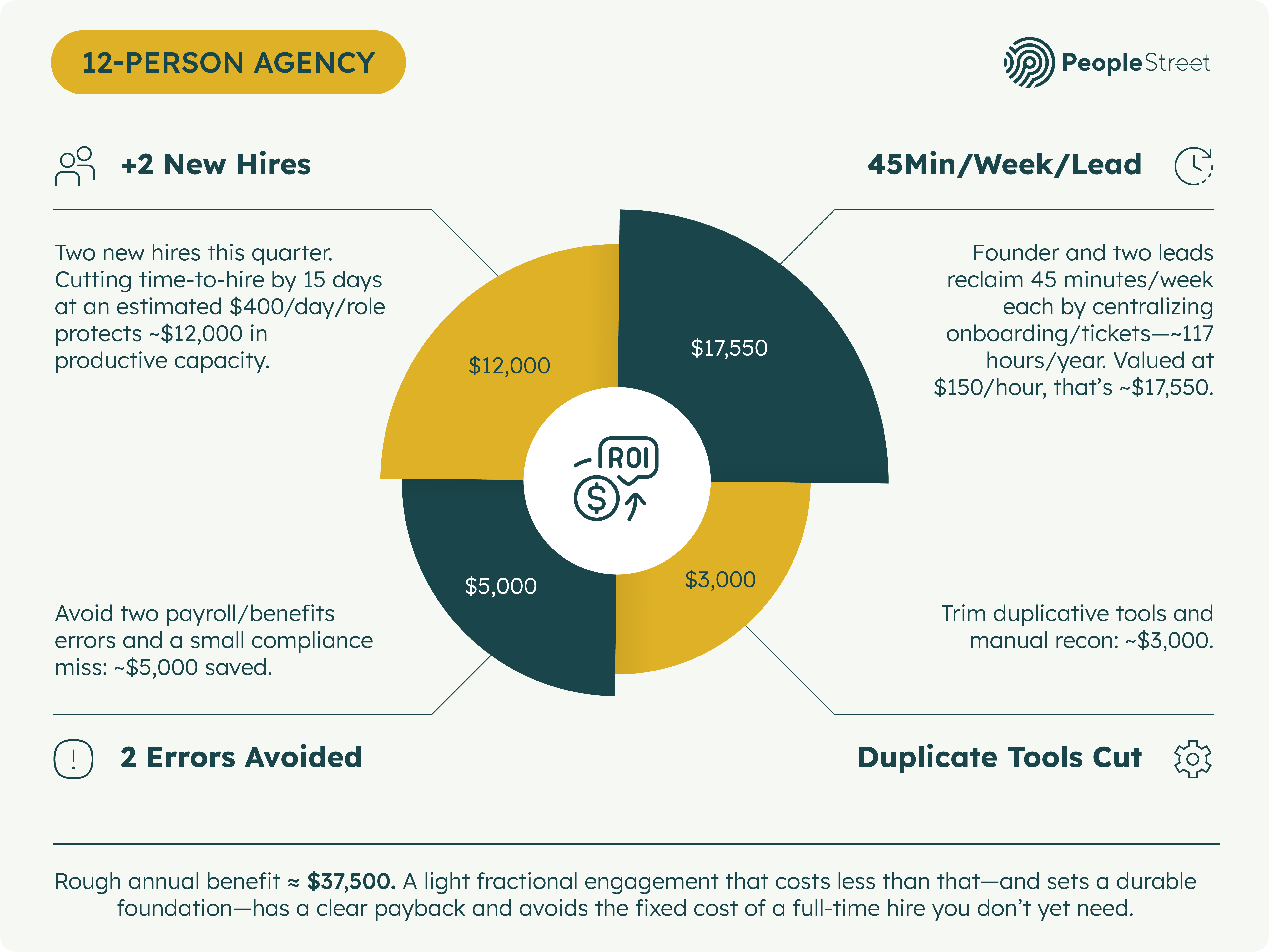
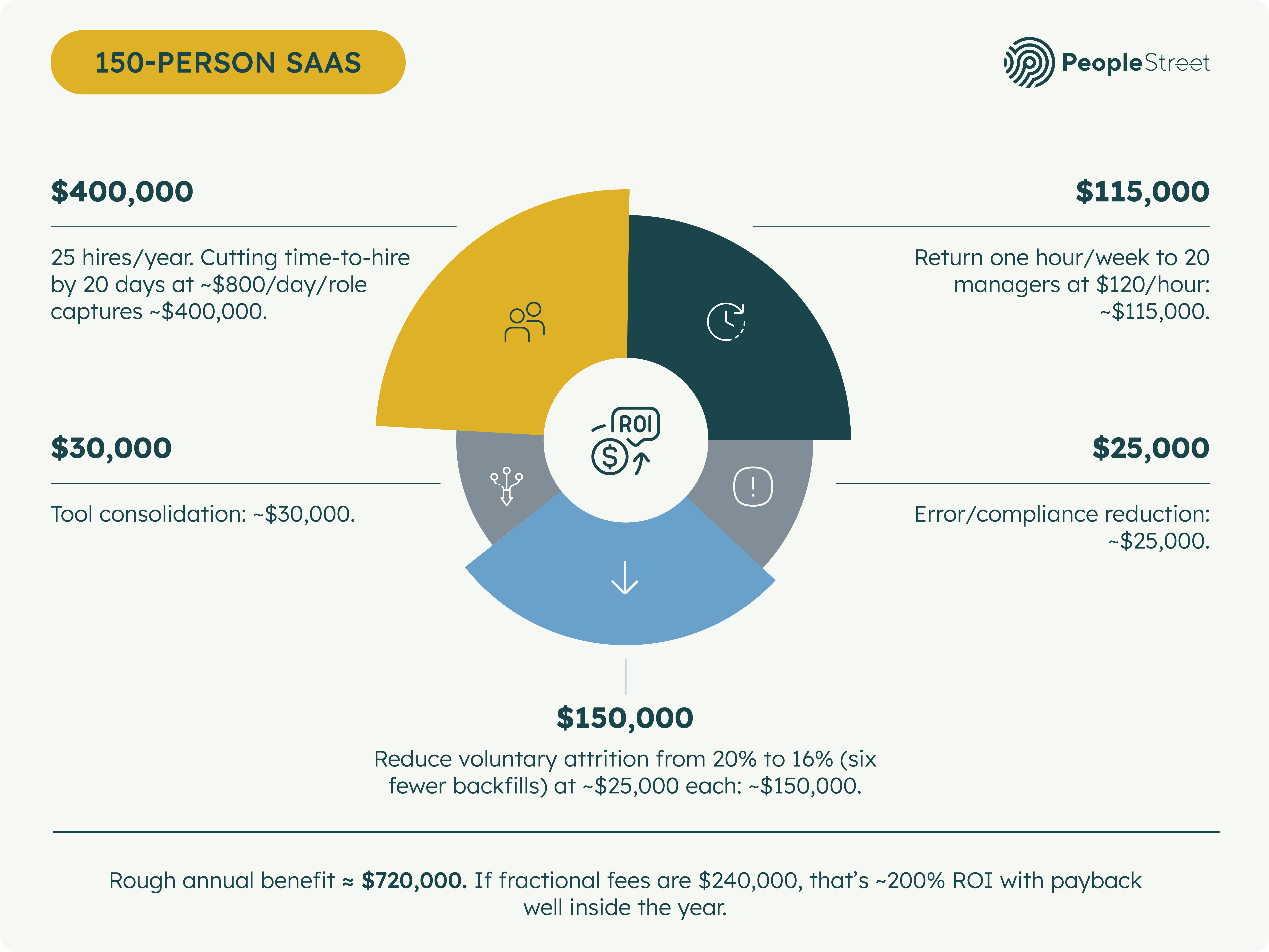
Are these your exact numbers? Probably not. But they’re close enough to start a leadership conversation and a spreadsheet where finance can plug real assumptions.
What good looks like in 90 days
- Month one: stabilize the highest-impact failure points and stop the compounding errors.
- Month two: clean the data, connect the stack, and lock workflows so execution becomes repeatable.
- Month three: run the cadence – tickets, onboarding, benefits ops, reporting – and document governance so it holds under growth.
People Street’s take
Most companies stay on the wrong model six to twelve months longer than they should. The PEO that made sense at 30 employees is creating drag at 80. The in-house hire that was supposed to build the system is still doing data entry nine months in.
The cost of the wrong model isn’t just the fees. It’s the compounding operational debt – dirty data, broken workflows, and a people function that leadership has quietly stopped trusting.
We implement on Rippling and HiBob and run managed people ops for VC and PE-backed companies at exactly this inflection point. If you’re trying to make this call, that’s the 20-minute conversation worth having now.
– End –